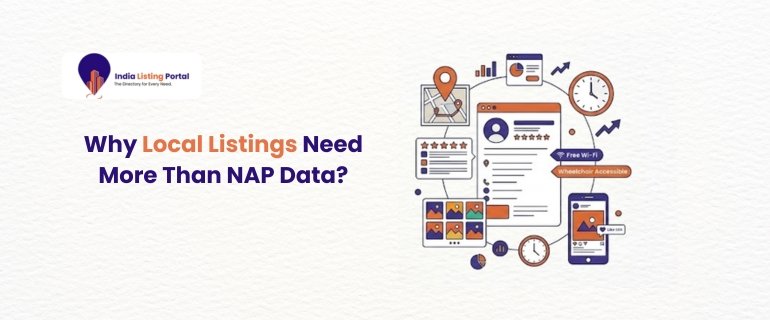
Local Listings Are the Foundation, Not the Whole Structure
Most people who run a business see their Local Listings as a checklist of paperwork: enter the business name, add the address, paste the phone number, and file it. Name, Address, Phone was a trio that was known as NAP data and, for years, was considered the end of the line in local visibility. It isn't. NAP data signals to Google that your business is real and where to find it. It doesn't let Google, or the person scrolling through search results, know whether your business is worth selecting. In 2026, both ranking and getting the click will rely on a much broader range of signals than a properly formed address. This post unpacks all of that: what is included in NAP data, what is missing, and what a truly comprehensive local listing might look like.
Key Takeaways
-
NAP data confirms your business's existence, but not your business's deservingness of ranking.
-
Citation signals have genuine but lesser weight in rankings, and on-page and engagement signals have more weight.
-
An unfettered Google Business Profile with categories, photos, posts, Q&A, and responses to reviews is more effective than the NAP-only profile.
-
But consistency still matters: if the NAP is mismatched between directories, entity confusion will occur that good content can't easily fix.
-
Local SEO in 2026 rewards profiles that are actively maintained, not ones that were set up once and forgotten.
What NAP Data Actually Covers (and Where It Stops)
NAP data is what you think it is: your business Name, Address, and Phone number, all of which are the same in every directory, map, and citation about your business. Its job is narrow but important. It helps Google's algorithm verify that the business on your website is the same business listed on Justdial, Yelp, or a niche-related directory site, and it also helps data aggregators move accurate information downstream.
Where NAP data stops is just as clear. It doesn't indicate whether your business description is helpful, whether your categories align with what customers are searching for, how recent your updates are, or how you respond when a customer leaves a review. A listing may be perfectly consistent in its NAP and yet be outranked by another that has a thinner citation profile but a much more active, detailed profile. Consistency earns trust; it does not earn engagement.
Google Business Profile (GBP) Needs More Than a Verified Listing
One of the most typical local SEO errors we encounter is assuming that your Google Business Profile is “verified” after you only have to wait a few days. A verified badge confirms ownership. It does not indicate completeness. Profiles with complete company information usually rank higher than partially filled ones. This is because any blank field represents a missed opportunity to help the searcher find exactly what they're looking for.
A GBP that is working hard for your business typically has the following:
-
Accurate primary and secondary categories reflecting the way customers are searching rather than the fancy name of the category.
-
Regularly updated photos, including interior shots, completed jobs, and team photos, since fresh images correlate with stronger engagement
-
Weekly or biweekly GBP posts about offers, projects, or updates on their profile, indicating an active and maintained profile.
-
Prompt, specific review responses that naturally include service and location keywords
-
A complete Q&A section that answers the questions customers ask before calling.
All of these live outside your NAP data. Each affects whether your GBP appears and whether someone who finds it wants to call.
Local SEO Signals That Sit Beyond Your NAP
Local SEO in 2026 is more of a constant reputation management process than a one-time job. Citation and NAP consistency are also important, but do not overpower other signal groups:
-
Check volume, recency, and response rate: consistent volume of recent, responded-to reviews means an active, reliable business.
-
On-page local signals: NAP on your website, location-specific landing pages, LocalBusiness schema markup
-
Backlinks and prominence: mentions and links from local press, industry associations, and reputable directories
-
Mobile experience: Google prioritises the mobile version, so if your mobile site is garbage, it will slowly kill your listing.
-
Engagement signals: Clicks, calls and directions from the listing itself
A business that gets NAP consistency right but fails to consider these other factors is optimizing for entry, not ranking.
NAP-Only Listings vs. Complete Local Listings
|
Factor |
NAP-Only Listing |
Complete Local Listing |
|
Business existence confirmed |
Yes |
Yes |
|
Categories matched to search intent |
Rarely reviewed |
Actively optimized |
|
Photos and visual proof |
Minimal or outdated |
Refreshed regularly |
|
Review management |
Ignored or inconsistent |
Monitored and answered |
|
Posts and updates |
None |
Weekly or biweekly |
|
Local SEO impact |
Baseline trust only |
Stronger Map Pack visibility and clicks |
How to Build Local Listings That Actually Convert
You don't need to rebuild a bare-bones listing to a full listing; you just need to focus on what gets prioritized:
-
Audit your NAP data first. Ensure your Name, Address, and Phone number are identical across your site, your GBP, and all directories you appear in, including abbreviations.
-
Fill every available field on your Google Business Profile, whether it's about your business hours, attributes, services, product listings, or any other sections.
-
Set a posting cadence and stick to it, even if it's just one update every two weeks.
-
Respond to every review, including negative reviews. A specific response to a negative review can build trust more than another five-star rating.
-
Add schema markup and a location page on your own website so on-page signals reinforce what your listing already says.
But if you're looking to audit your own listings, our post on business listing mistakes to avoid covers the issues that quietly destroy otherwise strong NAP data. How to create a perfect business listing profile covers the fields most businesses leave blank.
Conclusion
NAP data is only the entry ticket into local search; it’s not the entire show. It confirms the company exists and is available, but it says nothing about whether your categories match the searcher's intent, whether your photos are up to date, or whether you're responding to reviews. Real Local SEO performance in 2026 comes from filling out your Local Listings profile once and then updating it regularly, instead of filling it out and never looking at it again. Get the NAP data correct, then build everything else on top of that.
If you want a bit more detail on how directory listings can affect both local & organic rankings, read about it in Local SEO vs. Organic SEO: why directories matter for both, and for the mechanics of rankings, check out how local business listings help your local rankings.
FAQs
Q1. Is NAP consistency still important for local SEO in 2026?
Yes. NAP consistency is still important, but it now carries less weight than review activity, on-page signals, and profile completeness in Local SEO.
Q2. How do I make my Google Business Profile rank higher than just having correct NAP data?
Complete all sections of your GBP, upload new photos frequently, update regularly and respond to reviews promptly. Such engagement and completeness signals are as important as, or more important than, NAP accuracy.
Q3. What happens if my business listing has inconsistent NAP data across directories?
However, if you have inconsistent NAP information, Google's identity recognition of your business may be muddied, which can negatively affect trust signals and prevent your Local Listings from ranking in the Map Pack despite being otherwise optimized.
Setting up a correct listing is only step one. If your business is listed across directories with inconsistent NAP data, thin categories, or a stale profile, that gap is likely costing you visibility every month. List your business on India Listing Portal and build a profile that goes beyond the basics, or explore our full directory to see how complete local listings are structured.